Hole & lead review
Check finished hole sizes against lead diameters, press-fit specs and any odd-form parts that need fixtures.

XFPCB supports through-hole PCB assembly when connectors, terminals, transformers, relays or tall discrete parts need stronger mechanical joints than SMT alone can provide.

Through-hole parts insert into plated holes and are soldered from the opposite side - by wave, selective solder or hand soldering. This page covers THT-specific planning: hole size vs lead diameter, solder fillet criteria, press-fit vs soldered connectors and keep-out for tall parts.
Many boards combine SMT and THT. XFPCB sequences SMT first, then through-hole soldering, so heat-sensitive SMT packages are not reflowed twice without a plan.
Check finished hole sizes against lead diameters, press-fit specs and any odd-form parts that need fixtures.
Confirm pin-1, keying, height limits and which parts are auto-insertable vs hand-placed.
Choose wave for dense THT fields or selective/hand solder when SMT parts sit close to THT pads.
Trim leads to drawing, clean if required, and inspect fillet wetting and connector seating.
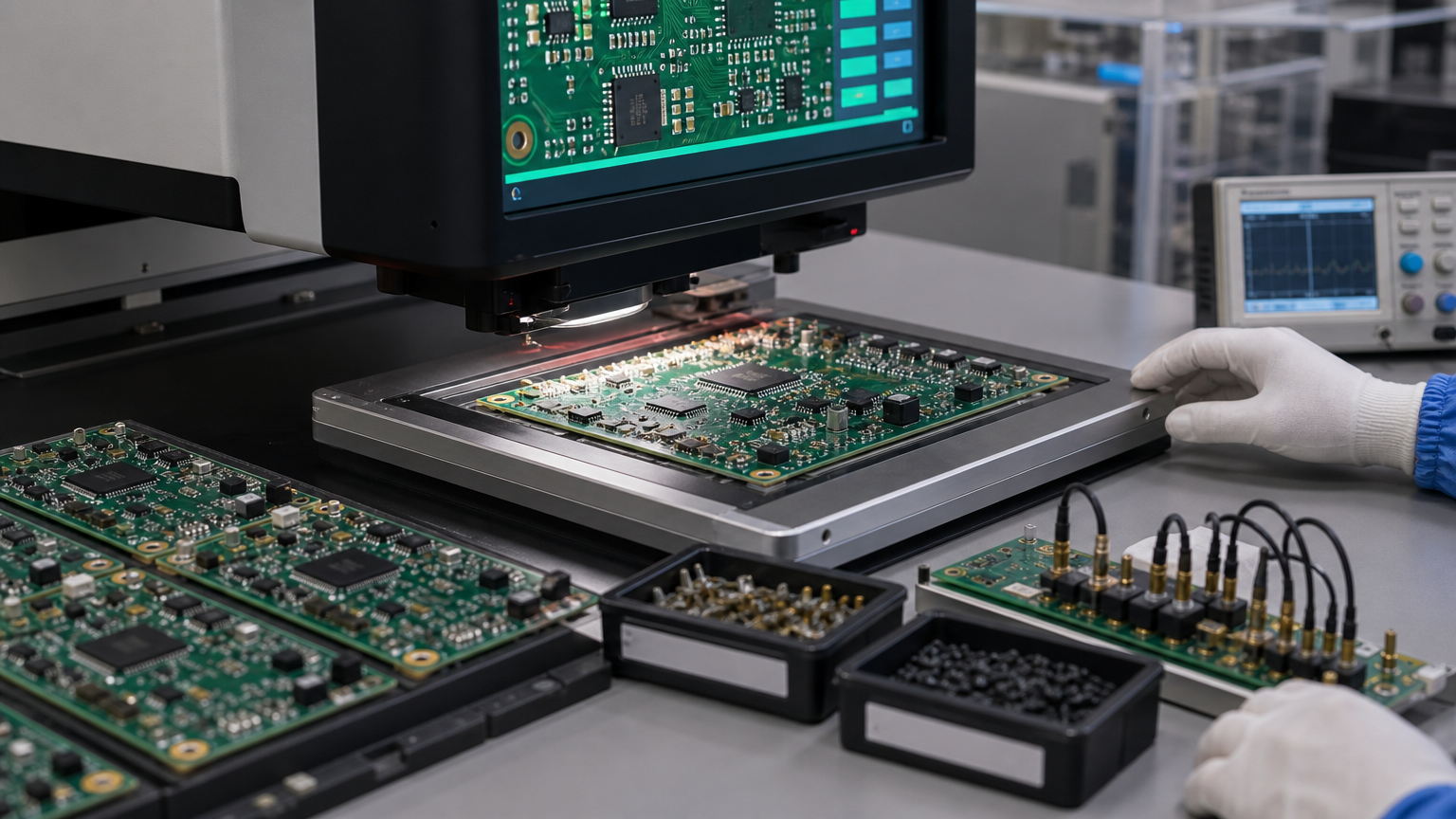
| Project Area | XFPCB Guidance |
|---|---|
| Typical parts | Connectors, relays, transformers, switches, terminal blocks, large electrolytics |
| Soldering options | Wave, selective solder, or hand solder for low volume / odd-form |
| Mechanical checks | Pin seating, keying, lead trim length, strain relief |
| Often paired with | SMT on the same board (mixed-technology PCBA) |
We verify keying, pin count and soldering side against your drawing so housings are not installed reversed.
Dense THT fields may run wave; boards with nearby SMT usually need selective or hand solder to protect fine-pitch parts.
Lead length after trim and acceptable fillet wetting are confirmed before operators start a production lot.
Send Gerbers, BOM with MPNs, assembly drawing showing orientation and height, and note which parts are wave-soldered vs hand-soldered. Photos of odd-form parts help.
We plan wave or selective solder based on board layout. If SMT parts sit close to THT pads, selective or hand solder is usually safer.
Yes. Most production boards are mixed. SMT is typically completed first, then through-hole soldering and final inspection.
Clear pin-1 / keying marks on the drawing, correct hole sizes, and a first-article check of seating height before the full lot proceeds.
Tell us which parts are through-hole, how they must be oriented, and whether wave or selective solder is preferred.