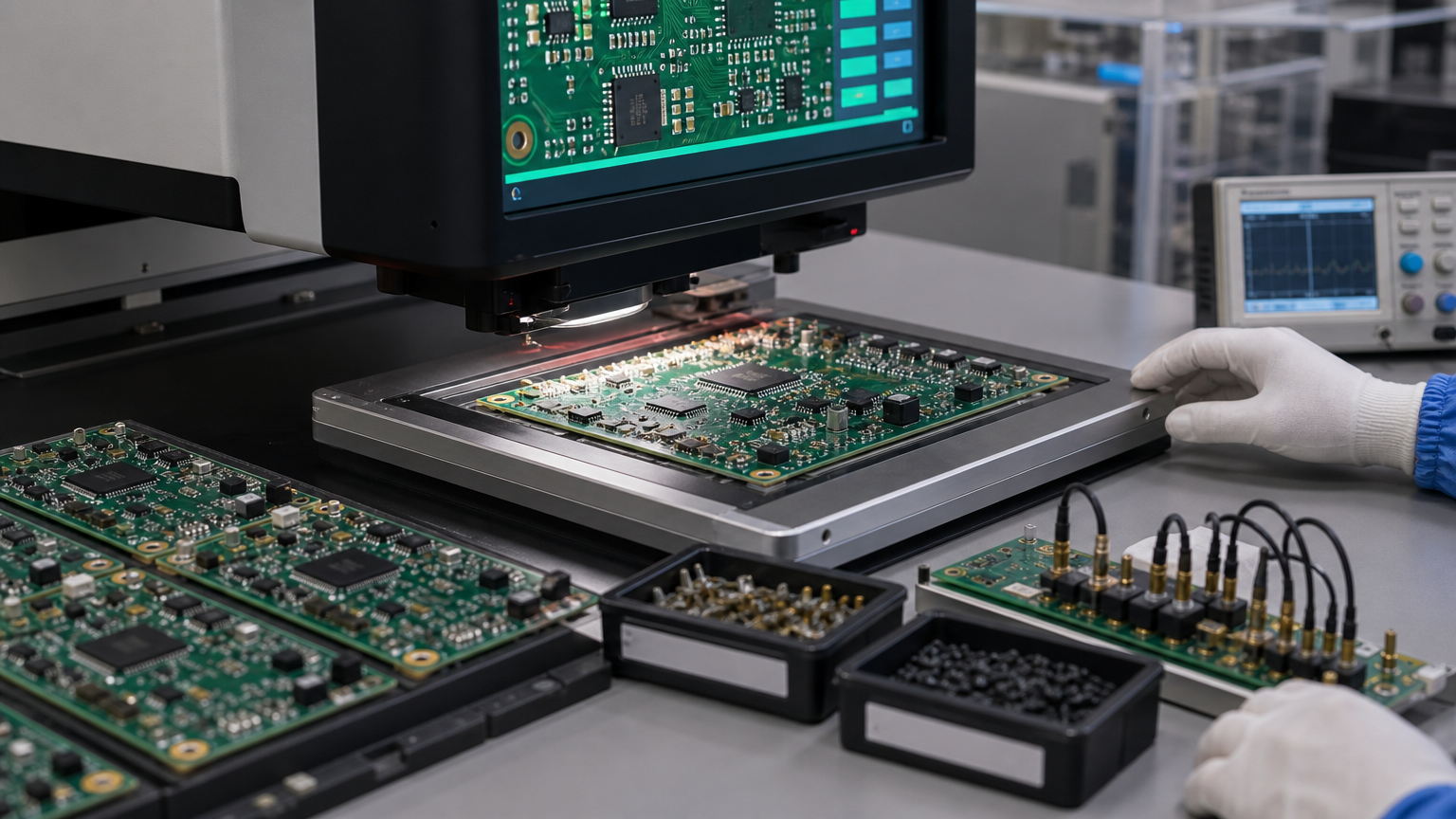
Manual visual inspection cannot keep up with 0402 passives, fine-pitch QFNs, and boards that leave the line every few seconds. Defects that escape to the next process become expensive; defects that escape to the customer become reputation damage. Automated optical inspection exists to put a fast, repeatable camera-based gate on visible SMT problems.
What AOI is not: a certificate that every joint on the board is good. Hidden joints under BGA and many bottom-termination packages still need other methods. Overseas buyers who treat "AOI included" as universal proof often discover that escapes and false-call floods were never designed out of the quality plan.
How AOI looks at a board
AOI systems capture high-resolution images under controlled lighting and compare them to a golden board or to CAD/Gerber-derived models. Typical catches include missing or shifted parts, polarity and orientation errors, solder bridges, insufficient solder on visible joints, tombstoning, and foreign debris or obvious copper issues on bare boards.
Placement in the line matters. Some factories inspect after paste (or use dedicated SPI), some inspect after placement before reflow, and most run post-reflow AOI for soldered assemblies. PCB fabricators also use AOI on bare boards for etch and registration issues before assembly ever starts.
2D and 3D are different tools
2D AOI is fast and effective for placement, polarity, and many bridging defects. 3D AOI adds height and volume information that helps judge solder joints and coplanarity, which becomes more important as pitches shrink. Neither replaces X-ray for joints you cannot see.
False calls are an operational tax. Weak recipes, stale golden boards after an ECO, and lighting that was never tuned for a new mask color can choke the line with nuisance stops or, worse, encourage operators to loosen thresholds until real defects pass. Recipe revision control belongs next to Gerber revision control.
Where AOI sits among other gates
SPI watches paste before parts land. AOI watches visible assembly defects. AXI/X-ray looks inside or under packages. ICT checks electrical opens, shorts, and many value errors with fixtures. Functional test asks whether the product behaves. Each gate covers a different failure class; stacking buzzwords without a matrix wastes money and still leaves holes.
Business value shows up as higher first-pass yield, less scrap and rework labor, and traceable defect images for customer or internal audits. ROI depends on volume and defect cost, not on owning a particular camera brand.
Writing AOI into an overseas RFQ
Name which stages are required, whether 3D is expected for fine-pitch work, how golden boards are maintained, and the rule that AOI does not replace X-ray for hidden joints. Tie disposition rules to IPC acceptance classes you actually buy.
XFPCB quality planning covers testing and inspection options including X-ray inspection when area-array risk requires it. Broader quality management expectations should match the package mix on your BOM, not a generic "optical inspection done" checkbox.