
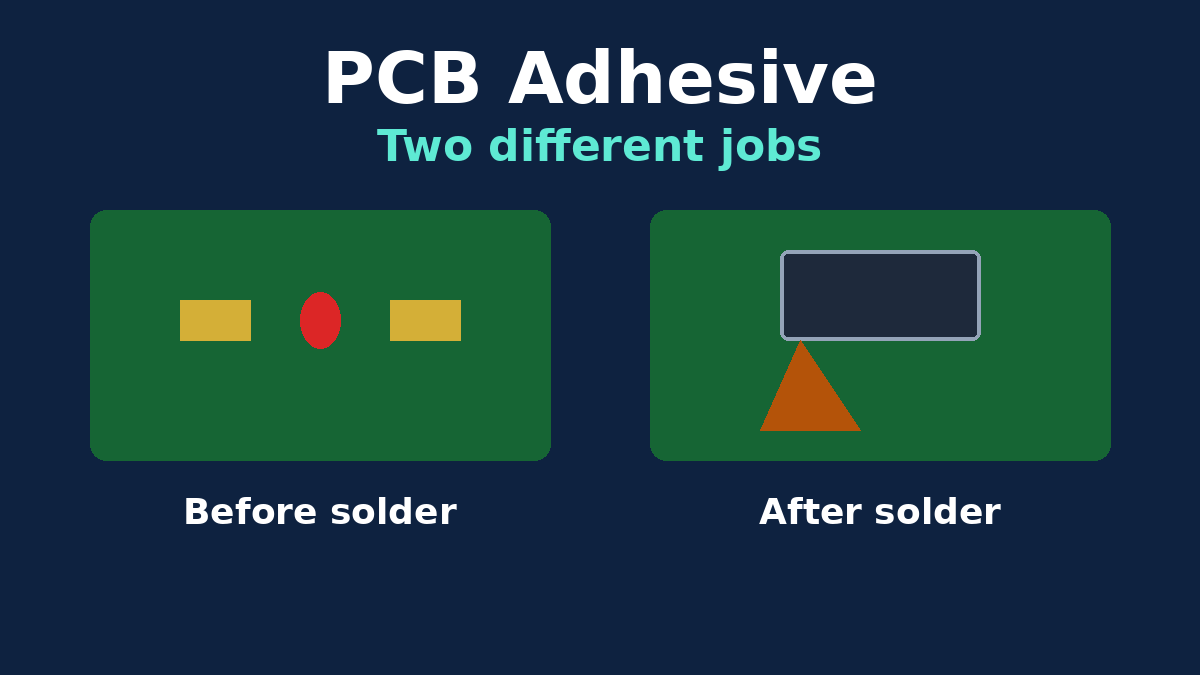
An assembly line sees two requests that both arrive as "glue the parts." One is a process material that has to be on the board before soldering. The other is a mechanical stake that only makes sense after the joints exist. Mixing them up is how adhesive ends up on pads, or how a rigid epoxy is asked to solve a vibration problem it will only pass into the solder.
Two jobs that should not share a line on the drawing
Process adhesive, usually the red SMT glue (sometimes yellow), holds a component against the laminate so it stays put through a later soldering step. The usual case is bottom-side chip parts on a board that will see a wave, or a selective-solder pass, after the top side has already been reflowed. The glue is dispensed or printed onto the laminate between the pads, the part is placed into it, and it is cured, typically with a short bake, before that soldering step. It is not the electrical connection. Solder is. After the joint is made, the cured dot is leftover process material. It was never selected as the product's vibration solution.
A normal double-sided reflow build does not need it. Paste holds each side through its own reflow, and the second profile is set so the first side stays attached. Red glue added "just in case" on a pure reflow board buys a cure cycle, a contamination risk, and a material that is awkward to rework, without holding anything the paste was not already holding.
Staking is the other job. It happens after soldering, on parts whose mass, height or leads will fatigue the joints in shock, vibration or thermal cycling: large electrolytics, transformers, coils, wire exits, some connectors. The adhesive bridges the component body to the board. That is a product requirement, so it belongs on the assembly drawing against reference designators, not as a verbal note to add some glue if a part looks loose.
Our Through-Hole Assembly page is where wave solder is weighed against selective solder for connectors and tall parts. That choice is what decides whether bottom-side chips need process glue at all, or whether a fixture and a selective nozzle can keep glue off the board.
Epoxy, silicone, and the materials people substitute
Epoxy is the usual stake when the part must not move: a rigid fillet, useful heat resistance, and a bond to solder mask that holds. Rigidity is also the drawback. A hard fillet on a ceramic body, or one that locks a component while the board flexes, moves the strain into the joint or the part instead of absorbing it. Epoxy is effectively permanent. If you expect to rework the part, say so. A stake across the whole body turns a short iron job into a scraped pad.
Silicone is the stake for boards that move: vibration, connector insertion, thermal cycling between a tall can and the laminate. It stays compliant, which is why it is a poor structural adhesive, and why that is acceptable.
It has to be an electronics grade. Acetoxy-cure sealant, the kind that smells like vinegar while it cures, releases acetic acid and is avoided on assemblies because that acid attacks metal. A neutral-cure silicone sold for electronics is what the bench should have. Household hot melt is a temporary fixture aid. It softens in a warm enclosure and creeps, so it is not a stake.
Three neighbours get lumped into "glue" and should stay off this note:
- Underfill is flowed under a BGA or chip-scale package and cured so the package and the board move together. It is not a dot beside a capacitor, and it has its own void and rework rules.
- Electrically conductive adhesive is an interconnect for joints you cannot solder. It is the wrong material for holding a part down.
- Conformal coating is a thin film. A heavy coat can add a little damping. It does not replace a stake on a large electrolytic.
IPC-HDBK-4691 is the assembly handbook that treats these as different bonding jobs. You do not need to cite it on the drawing. You do need the drawing to name the job.
Where the material is allowed to sit
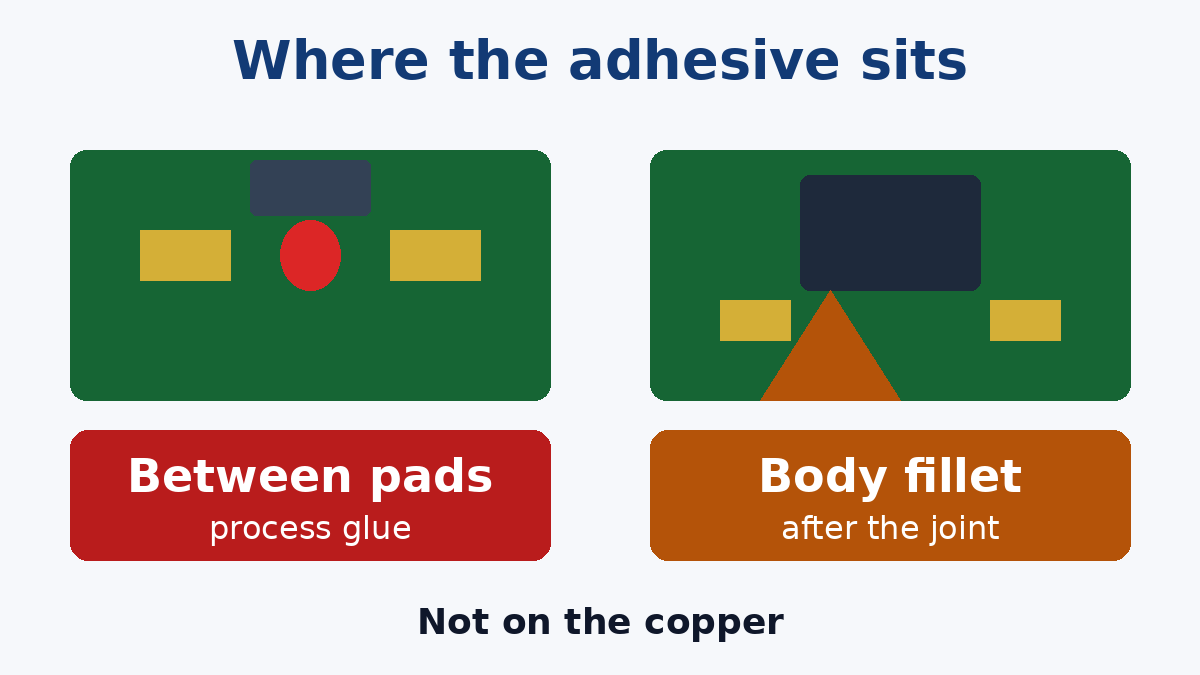
Process glue sits on the laminate, between the pads, clear of the copper. If it wets a pad, that pad will not take solder. Glue that is stencil-printed needs its own stencil. It does not share the paste stencil.
A stake sits on the component body and the board, and stays away from:
- joints you still need to inspect or rework
- test points, gold fingers and connector mating faces
- adjustable parts, labels, and shields that have to come off
- the toe of a fine-pitch lead, where a fillet becomes a short or a bridge
One fillet on the side of the body away from the leads is usually enough. A ring of adhesive all the way around a part looks thorough. It also traps flux, hides the joints, and locks the part harder than the joint was designed for.
Cure, then the next heat
Process glue is cured before the wave or the next solder step, on the schedule that glue actually needs. A half-cured dot lets the part skate across the wave and leave the pad.
Staking is cured after soldering. If that cure is a heat cure, the temperature has to stay inside what the assembled board can take: the parts, the joints you just made, and the laminate. A temperature copied from a structural-epoxy datasheet is not automatically a board cure.
Neither material should be asked to rescue a pad that is too small or a lead that was never formed. If the joint is the problem, the joint is what gets fixed.
What the assembly note has to contain
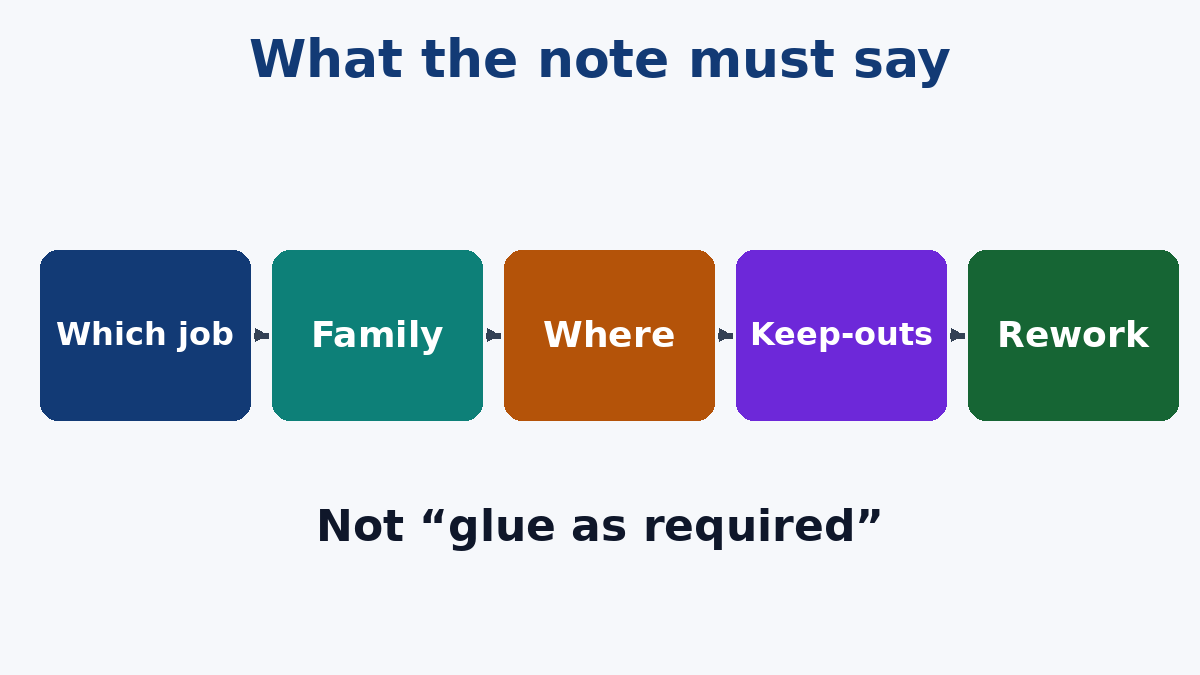
A line the factory can build from has five parts:
- Which job. Process adhesive for named bottom-side parts, or staking for named reference designators. Not "glue as required."
- Family and cure. One-part heat-cure epoxy for process glue. Rigid epoxy or neutral-cure silicone for staking. A qualified part number if you have one. If you do not, name the family and add "electronics grade, non-corrosive cure, or equivalent," with a sample you approve before the run.
- Where. Between the pads and not on them, or a body fillet on the side the drawing marks, with a maximum height if it matters for the enclosure.
- Keep-outs. Test points, fingers, press-fit zones, coating windows.
- Rework. Whether the stake may be cut away and replaced, or whether that part is not expected to be repaired.
If the drawing is silent, the line either skips the stake or uses whatever cartridge is already open. Both are worse than four lines of notes.
Our SMT PCB Assembly page describes the paste, placement and reflow path most boards stay on, including aperture and profile review before the line starts. Process glue is a branch off that path. It should be written as a branch, not assumed because the board has parts on both sides.
Before the quote goes out
- Bottom-side parts through a wave need process glue between the pads, cured before solder. A pure reflow build usually needs none.
- Tall or heavy parts in vibration need a stake after solder: silicone if the board flexes, epoxy if the part must not move.
- No acetoxy silicone, no hot melt as a permanent stake, and no conductive adhesive unless the joint itself has to conduct.
- Keep the material off pads, lead toes, test points and connectors.
- Say whether that part is supposed to be reworked later.
The adhesive is either a process step or a product requirement. The drawing has to say which, because the factory cannot tell from the word glue.