
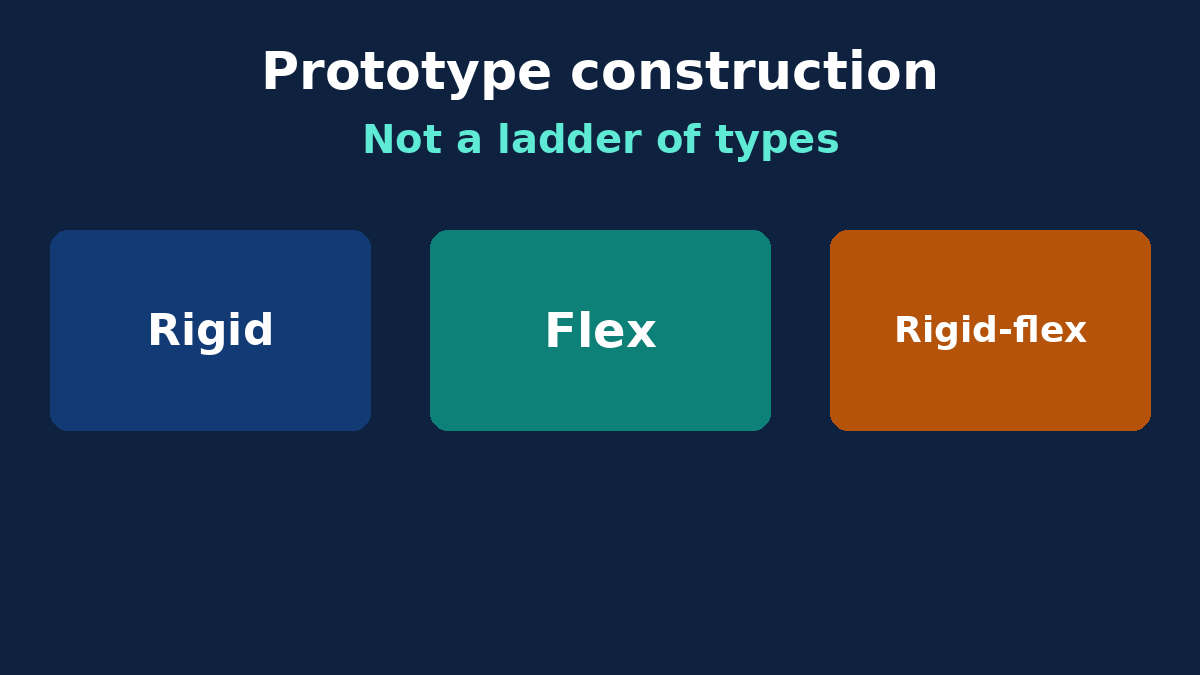
Catalogues treat "prototype type" as a ladder: single-sided, then double-sided, then multilayer, then flex, with quick-turn as a speed setting beside them. A factory does not build that ladder. It builds a construction. If the thing you are worried about only exists in one construction, a cheaper construction is not an early version of it. It is a different board, and a pass on that board does not travel.
The list is constructions, not grades of prototype
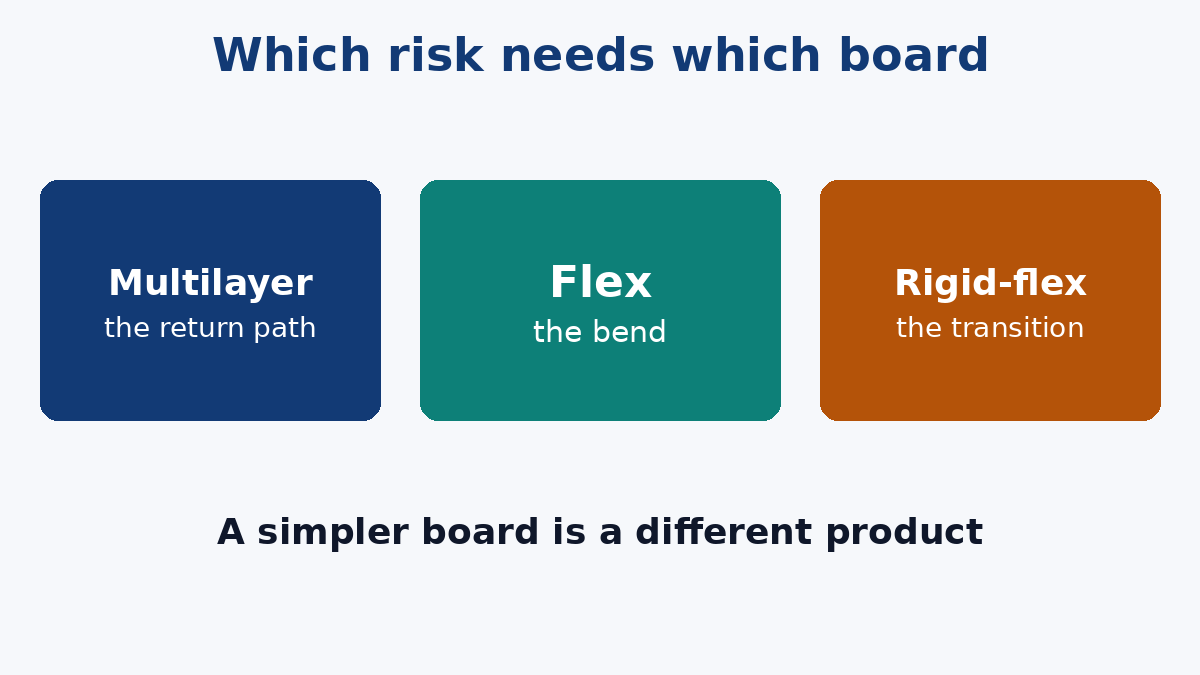
One copper layer, or two. Fine when the product really is that board: a simple interconnect, a power switch, a panel with a few connectors. A two-layer spin of a product whose return path, impedance or plane split only exists at four layers or more has tested the two-layer circuit. Our Multilayer PCB Guide is the stack from four layers upward. If that stack is the product, the prototype has to be in it, at least for the nets that use it. You can delete unrelated circuitry. You cannot delete the layer the noise was going to return on and then say the layout is quiet.
Flex. A rigid rectangle does not bend, and it does not have a coverlay. The failures people discover on flex — copper cracked at a fold, coverlay adhesive in a hole, a stiffener that lands on a joint — are not available on FR-4. Our Flexible PCB page is that build: polyimide, coverlay, and a review of the bend area. A rigid prototype can still be the right first object if you are only checking a connector pinout on the bench. It is the wrong object if the question is whether the tail survives being folded into the housing.
Rigid-flex. This is not "flex, plus some rigid PCBs screwed on." The rigid areas, the flex spine and the transition between them are one laminated piece. A pair of rigid boards and a flex jumper can be a sensible product. It is not a prototype of a rigid-flex stack, because the transition, the coverlay overlap and the way parts sit next to the bend are exactly what the one-piece build adds. Our Rigid-Flex PCB page is that integrated build: rigid areas for components, flex for the interconnect. Prototype the construction you will ship, or prototype the jumper version and call it the jumper version.
State static or dynamic on the drawing if the circuit bends. A board that is folded once at assembly and a board that flexes in use are not the same mechanical question, and a prototype that is never bent has not asked it.
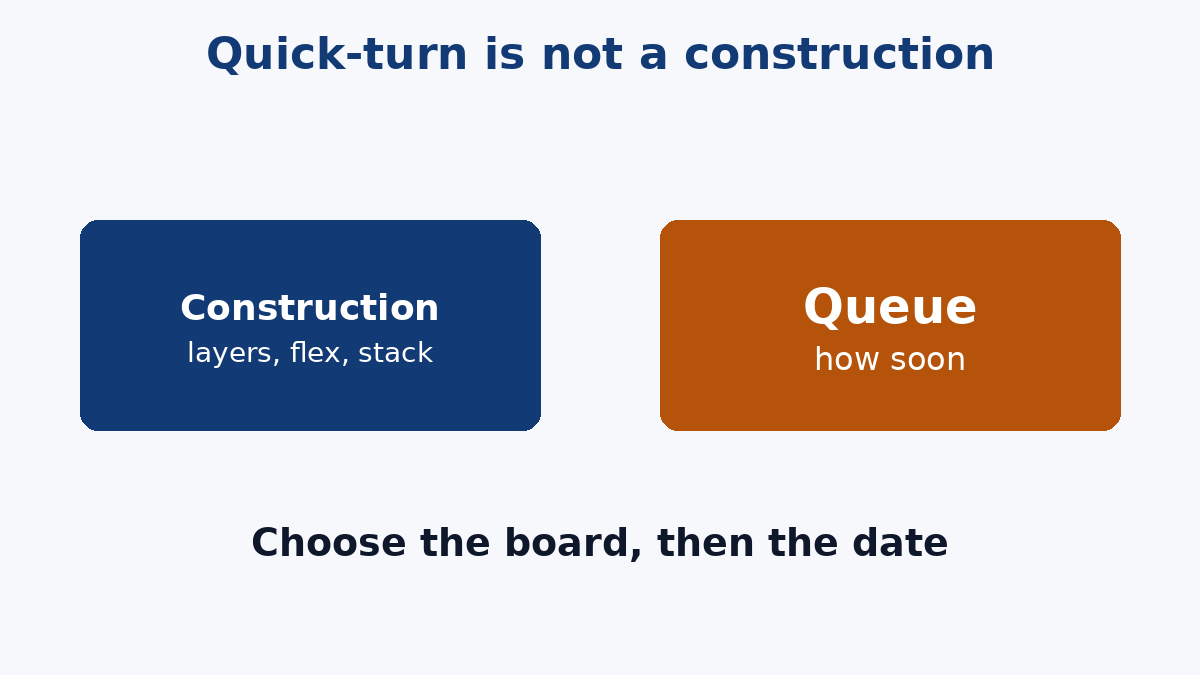
Quick-turn is a queue, not a type
Putting a job at the front of the line does not change the glass, the layer count or the bend. It changes how soon you get the construction you already chose. Our Quick Turn PCB page is that urgent path, with manufacturability still in the review. If the construction needs a material that is not on the shelf, or a sequential lamination, "quick-turn" does not delete those steps. It only tells you they will dominate the date. Choose the construction first. Then ask whether that construction can move quickly. The other order is how people order a two-layer board because it was the thing the calendar could hold, and then treat the result as news about a six-layer flex.
Mistakes that are really construction mistakes
A few failures get blamed on "prototyping" when the file and the construction disagreed.
The stackup is missing on a multilayer, or the bend is missing on a flex. A Gerber set without layer order is not a multilayer order. A flex outline without the bend line, the stiffener and whether the bend is once or repeated is not a flex order. The factory can guess. The guess is then what you tested.
Rules copied from the other construction. Trace-and-space habits from a rigid board, dropped onto a bend, put copper where it will crack. A rigid-flex transition copied as "just make this region thinner" skips the coverlay and the no-flow region the lamination actually needs. DFM is not one checklist you tighten. It is the checklist of the construction in front of you.
Assembly planned for a board the parts cannot sit on. A connector, a battery contact or a tall part on a flex tail needs a stiffener or a rigid island, decided before the spin, because the prototype that omits it cannot be assembled the way the product will be. If you are not ready to place those parts, say the spin is bare copper and outline only. Do not place them on a rigid stand-in and learn the wrong keep-out.
The simpler board kept the name of the harder one. Files named "rigid-flex proto" that are two rigid Gerbers and a cable drawing will be quoted as two rigid boards. That can be what you want. It is not what the filename said, and the passing result does not belong in the rigid-flex column of the report.
What to write on the prototype order
- The construction, in words that match the files: rigid, flex, or rigid-flex. Layer count. Not "prototype PCB" alone.
- The risk this spin is buying: return path on this stack, bend into this housing, transition at this stiffener. Unrelated circuitry can come off.
- For flex or rigid-flex: bend line, static or dynamic, stiffener or rigid-island location, and that a rigid stand-in is not being substituted.
- For multilayer: the stack you mean, even if the fab will return a buildable press. "Four layer, standard FR-4" is a construction. Silence is not.
- Quick-turn only after that list. It is not one of the constructions.
A prototype is evidence about the board you built. Order the construction whose failure would hurt, or accept that you have evidence about something else.