"Which is better, FR-4, aluminum or ceramic?" usually arrives with a table of thermal conductivity. The table is not the decision the factory makes. The decision is which process the board will walk through. A higher number on a datasheet does not move a job from a multilayer press onto a metal-base line, or from either of those onto a ceramic line.
Conductivity still matters when you compare two candidates that use the same process. It is the wrong tool for deciding that you have changed process. This note is only about that change.
FR-4 stays on the laminate press
FR-4 here means the ordinary rigid board: glass cloth, epoxy, copper foil, stacked and pressed, then drilled and plated. Multilayer routing, a through-hole that connects layers, and a controlled-impedance note all assume that process. The glass-epoxy itself is a poor heat conductor. That is the reason people go looking for aluminum or ceramic. It is not a reason to write "high thermal FR-4" and hope the press produces a heatsink.
While the board is still in this family, the choice is a laminate choice: standard epoxy, a higher Tg, a lower-loss grade, a flex film, or a metal core called out as its own construction. Our PCB Materials page is that list — FR-4, high-Tg, RF laminates, flex and metal core — not a ceramic catalog.
Aluminum is a plate, a thin dielectric, and one copper layer unless you say otherwise
A common aluminum board is insulated metal substrate. Copper foil, a thin polymer dielectric, an aluminum plate. Heat reaches the plate because that dielectric is thin, not because the resin has stopped being a polymer. Our Aluminum PCB page is this heat-spreading build for LED and power boards.
The shop does not run it as "FR-4, but the core is metal":
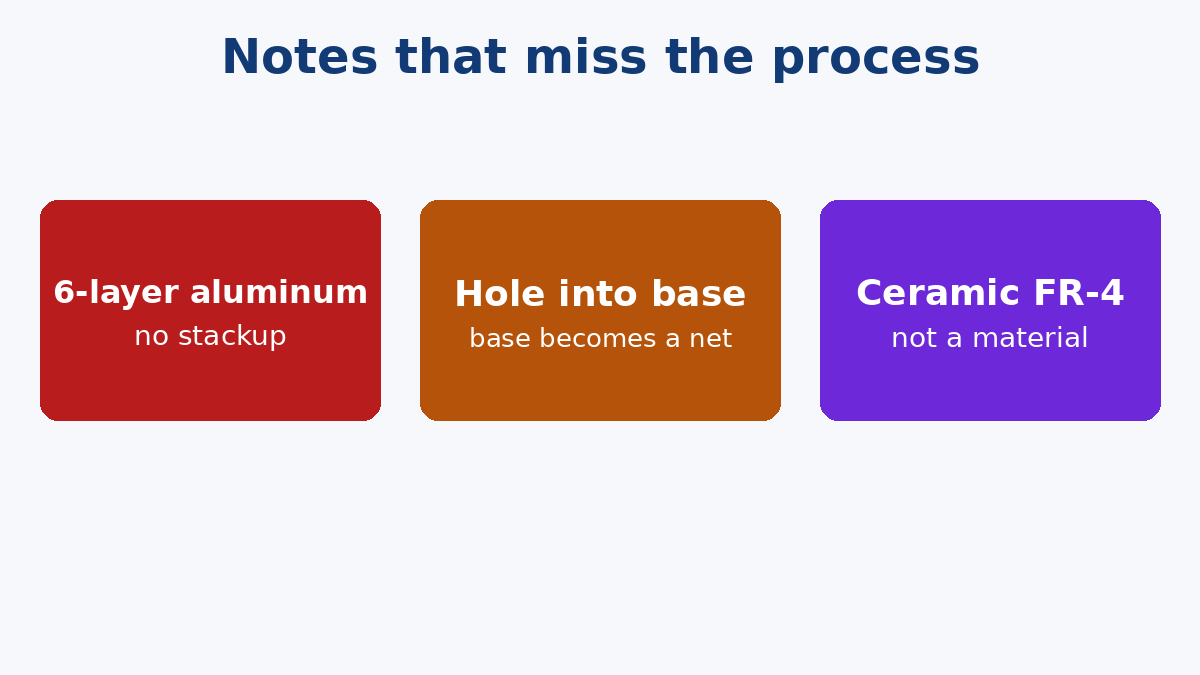
- Layer count is not the FR-4 menu. One copper layer is the usual board. More copper layers, or a multilayer bonded onto a base, are separate constructions and need a stackup. "6-layer aluminum" with no stack is not an upgrade of a 6-layer FR-4. It is an undefined job.
- A plated hole wants to touch the plate. Drill through the aluminum and plate the barrel, and the circuit is now connected to the base. The base is the heatsink, and sometimes the chassis. If the base must stay off the nets, the hole is unplated, or it is plated with a resin barrier that keeps the barrel off the metal. The drawing has to say which. Silence gets you a short, or a question.
- The thin dielectric is the whole insulation. Withstand voltage, if the product needs it, is a property of that layer's thickness and material. It is not a property of "using aluminum." Our Metal Core PCB page puts dielectric reliability next to the heat path, which is the right pairing: the same thin layer has to do both. Copper or steel bases exist for other mechanical reasons. They are still this process, not an FR-4 stack with a metal sticker on the back.
Solder mask and finish still get specified. Scoring, routing and punching do not copy from the FR-4 traveler without someone looking at the plate thickness. Ask before you reuse the FR-4 fabrication notes verbatim.
Ceramic is a substrate line, not a laminate grade
Alumina or aluminum nitride, with copper attached by a direct bond or a direct-plate process, is how some power modules and high-temperature circuits are built. The copper is on a ceramic, not on a pressed glass-epoxy core. It does not go through the FR-4 book. Panel size, hole process, mask and how many copper layers you can have are whatever that ceramic process does. They are not the options on an FR-4 quote form.
"Ceramic FR-4" is not a material. A controlled-impedance multilayer "but make it ceramic" is two products forced into one sentence. If the power device sits on ceramic and the control circuit sits on FR-4, those are two part numbers, and the connector or bond wires between them are a third question. Do not bury that in a single stackup note.
Nothing here is a claim that every ceramic construction is available on the same quote as an FR-4 prototype. It is a claim that sending the ceramic as if it were a laminate callout wastes the round trip. Say alumina or aluminum nitride, say how the copper is attached if you know, and keep it off the FR-4 traveler.
What the RFQ should name first
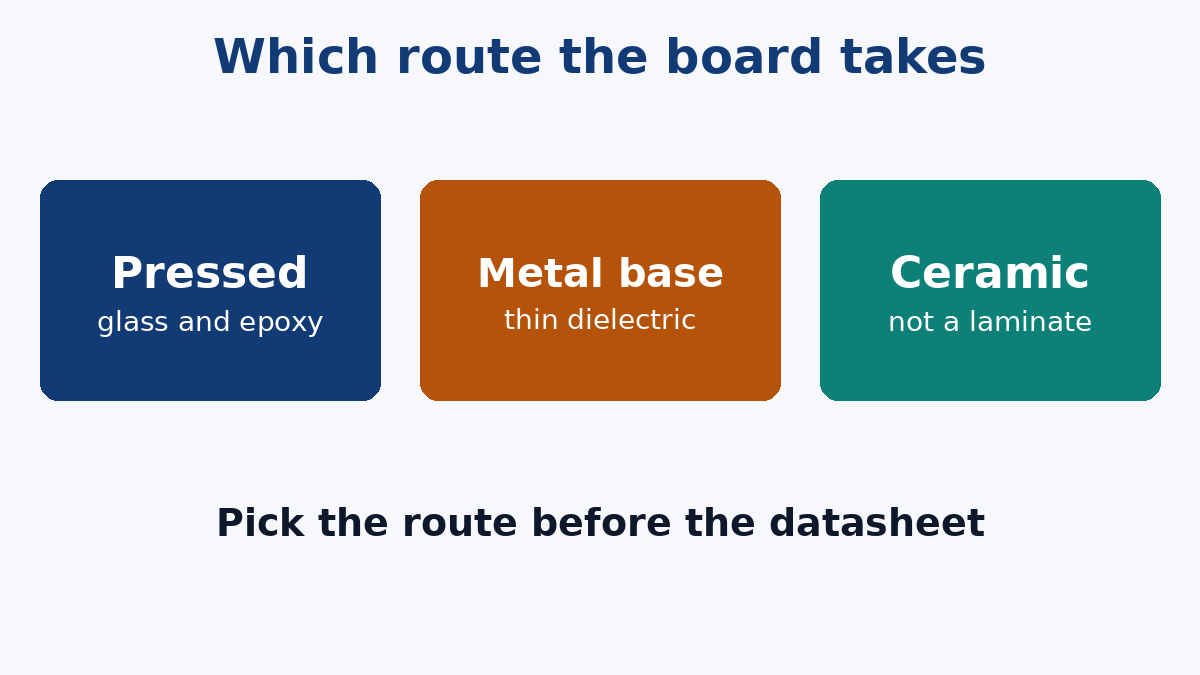
Name the process before any property:
- Pressed laminate. Then the laminate note (resin family, Tg, loss if it matters). Do not add "aluminum for cooling" on the same line.
- Metal base. Copper-layer count, whether the base is a net, how holes are kept off the metal, and the dielectric withstand if you need one. Aluminum is the usual plate. If it is not aluminum, say so.
- Ceramic substrate. Which ceramic, how the copper is attached, and that it is not the FR-4 stack.
Compare thermal conductivity only after those three are not being mixed. Two aluminum dielectrics can be compared with each other. An aluminum datasheet and an FR-4 datasheet cannot be compared into one build.